jyfilter2@junyigl.com
+86 13916993659
Introduction
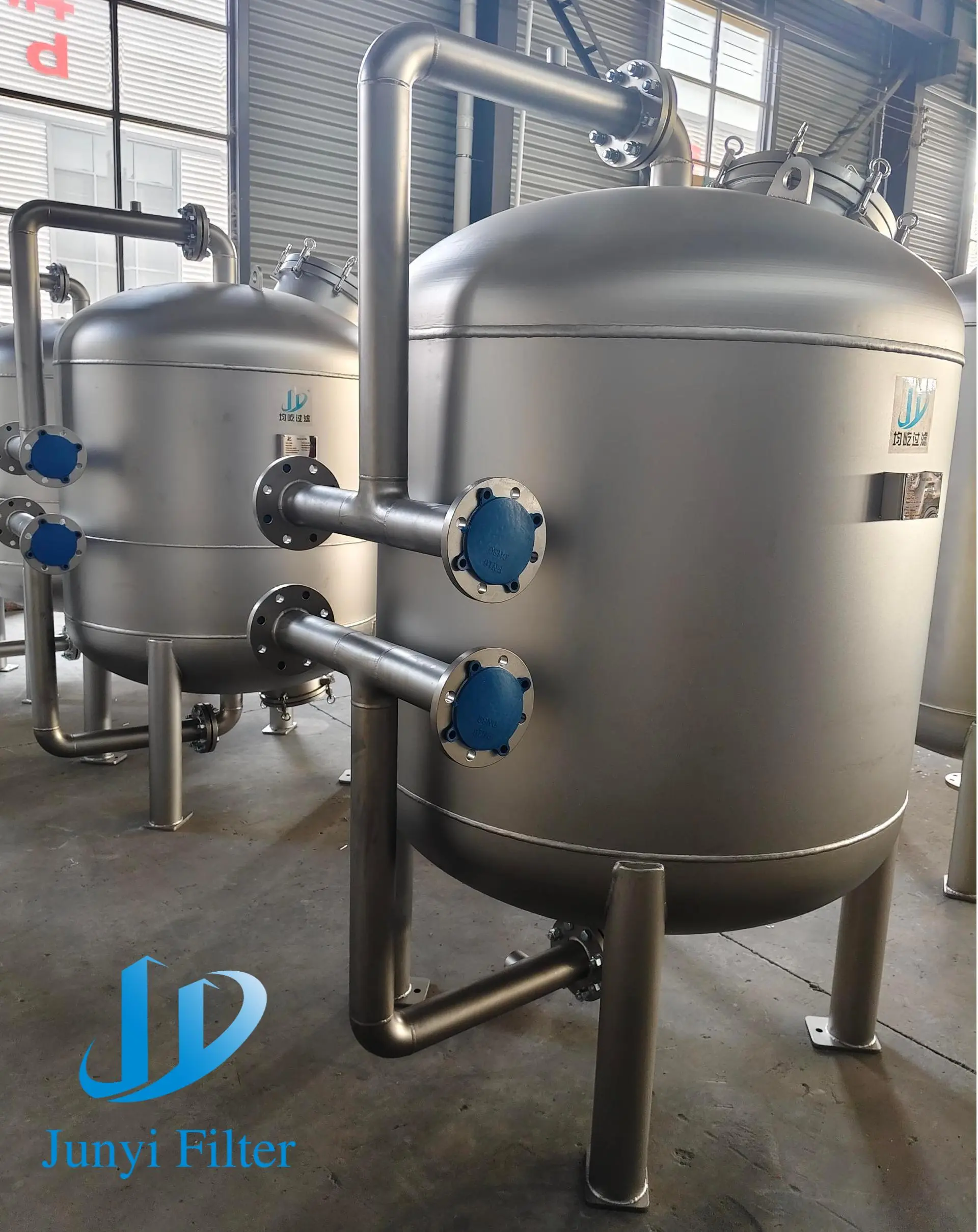
Shanghai Junyi Filter Equipment Co., Ltd. offers quartz sand filters, which are one of the most widely used filtration systems in the industrial water treatment field. Their working principle is built on a simple yet effective cycle: filtration + backwash regeneration. By combining physical interception, contact flocculation, and physical adsorption, these filters reliably remove suspended solids and improve water quality. This article breaks down the complete working process, from filtration to backwash and rinse, to show how quartz sand filters maintain performance over time.
Core Working Mechanism: How Filtration Works:
At the heart of a quartz sand filter is a multi-layer bed of quartz sand media, carefully graded by particle size—typically coarse on top and fine at the bottom. This creates a deep filter structure capable of trapping impurities at different levels.
1. Mechanical Interception (Straining)
As raw water flows downward through the sand bed, suspended particles such as rust, and algae are physically trapped between sand grains or within the pores. This works like a three-dimensional strainer, removing particles larger than the media pores.
2. Contact Flocculation (Removing Fine Particles)
Smaller particles—like colloidal matter or organic microparticles—are not easily trapped by size alone. However, as they move through the sand layer, they collide with sand surfaces. Due to surface charge differences, these fine particles adhere to the media and gradually form larger flocs, which are then retained in the bed.
3. Physical Adsorption (Enhancing Water Purity)
Quartz sand offers a relatively high surface area. Through van der Waals forces, it can adsorb dissolved organic compounds, some heavy metals, and color-causing substances. While this effect is limited compared to activated carbon, it still contributes to improved effluent quality in standard applications.
System Operation: Filtration, Backwash, and Rinse Cycle:
A quartz sand filter operates in a continuous loop, alternating between filtration and media regeneration. This cycle ensures consistent performance and long media life.
1. Filtration Stage (Normal Operation)
Flow Path: Raw water enters the top of the filter tank, passes through a distribution system, and flows downward through the sand bed.
Result: Solids are retained in the bed, and filtered water exits through the underdrain system at the bottom, ready for downstream use (e.g., reverse osmosis feed, cooling tower makeup).
Duration: Continues until pressure loss increases or effluent quality drops.
2. Backwash Stage (Cleaning the Media)
After a certain operating time, the filter bed becomes clogged with captured solids, reducing efficiency.
Flow Path: Water is directed upward through the bed at a higher flow rate, expanding and fluidizing the sand.
Result: Trapped impurities are sheared off the media surface and carried away by the backwash water, which is discharged to waste.
Purpose: Restores the sand’s cleanliness and porosity for the next cycle.
3. Rinse Stage (Return to Service)
Immediately after backwashing, the bed may contain residual backwash water and fine particles.
Flow Path: Water is again directed downward (normal flow direction) but sent to drain, not service.
Result: Removes remaining debris and stabilizes the bed.
Completion: Once the rinse water runs clear, the filter returns to filtration mode.
Conclusion
Quartz sand filters provide a reliable, low-maintenance solution for solid-liquid separation in industrial water systems. By combining mechanical straining, contact flocculation, and adsorption, and by using a simple filter → backwash → rinse cycle, these systems ensure consistent water quality and extended media life. Whether used in pretreatment for reverse osmosis, industrial circulation systems, or wastewater treatment, quartz sand filters remain a fundamental technology in modern water treatment.
For inquiries about our products or pricelist, please leave your email to us and we will be in touch within 24 hours.
INQUIRY NOWJunyi Copyright © 2025 ALL rights reserved